
Therapy with Philipp
PSYCHOTHERAPist IN Prestwich, Manchester & online

Internal Family Systems (IFS) Therapy
Understanding the Different Parts of You
Have you ever thought:
“Part of me knows I'm good enough, but another part still feels like a failure.”
“I want to say no, but something in me is terrified of upsetting people.”
“I know I'm safe now, but part of me still feels as though something bad is going to happen.”
We can understand something intellectually and still feel very differently inside.
Internal Family Systems (IFS) therapy offers a compassionate way of understanding these different sides of ourselves — particularly the protective patterns and emotional wounds that may have developed through difficult experiences.
Rather than asking, “How do I get rid of this part of me?”, IFS helps us become curious about why it is there, what it is trying to do for you, and what it might be protecting.

What is IFS Therapy?
Internal Family Systems is a trauma-informed psychotherapy developed by Dr Richard Schwartz.
IFS starts from the idea that it is normal to experience different “parts” of ourselves.
You might have a part that wants connection and another that keeps people at a distance. A part that wants to rest and another that tells you that you should always be productive. A confident adult part and another that can suddenly feel frightened, ashamed or very young.
You don't need to adopt any particular belief about what a “part” literally is to work in this way. I find parts language a powerful therapeutic framework for understanding different emotions, beliefs and protective responses with greater curiosity and less judgement.
And one of the most important principles of IFS is:
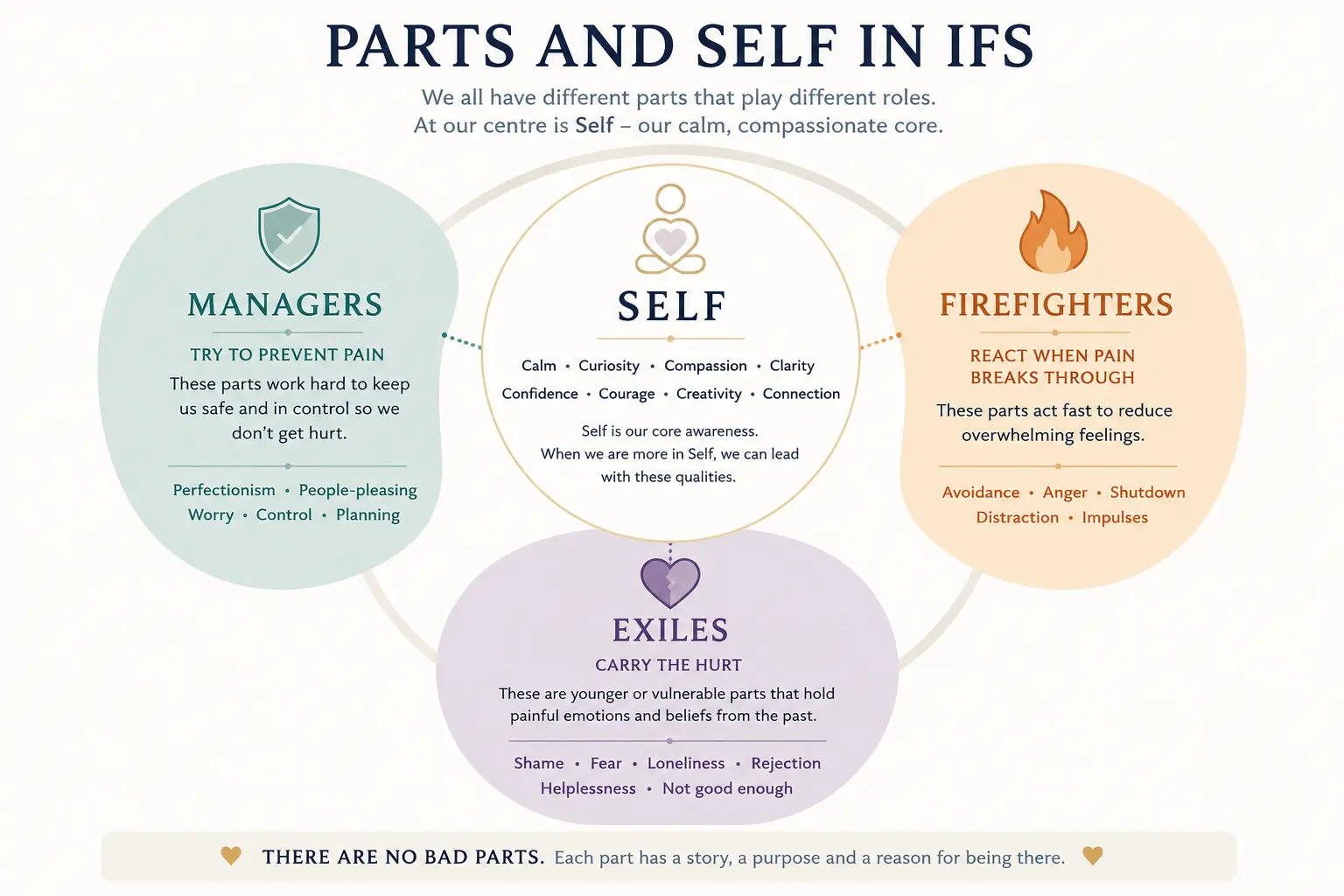
There are no Bad Parts
Some of the things we dislike most about ourselves may originally have developed for a reason.
A part might become:
- perfectionistic to prevent criticism
- a people-pleaser to maintain connection
- angry to prevent you from being hurt again
- controlling because uncertainty once felt unsafe
- emotionally detached because feeling became overwhelming
- highly anxious to constantly watch for danger
- avoidant because staying away feels safer than taking a risk
These strategies can become painful or restrictive in adult life. But IFS doesn't begin by fighting them.
Instead, we become interested in what the part believes it needs to do and what it fears might happen if it stopped.
Understanding the protective intention doesn't mean that we have to continue allowing a pattern to control our lives. It gives us another way of helping it change.
Managers, Firefighters and Exiles
IFS provides a useful map for understanding how different parts can take on different roles.
Managers try to prevent painful things from happening in the first place.
They may try to keep life under control through perfectionism, planning, worrying, people-pleasing, self-criticism, overworking or constantly anticipating what could go wrong.
Their message might be:
“If I get everything right, perhaps we'll be okay.”
Firefighters react when difficult emotions have already broken through.
They want relief now. This might show up through avoidance, shutting down, distraction, anger, impulsive behaviour or other ways of escaping overwhelming feelings.
Their message might be:
“I need to make this feeling stop.”
Exiles are the younger or more vulnerable parts of us that may carry painful emotions and beliefs from earlier experiences.
They might carry fear, loneliness, shame, rejection, helplessness or the belief that “I'm not good enough”, “I'm unlovable” or “I'm unsafe”.
Because these feelings can be so painful, other parts may work very hard to make sure we never experience them again.
This can create a cycle in which protective strategies that once helped us survive or cope eventually become part of what keeps us stuck.
What is the Self in IFS?
At the heart of IFS is the idea that we are more than our wounded and protective parts.
IFS describes a core Self, distinct from our parts, that has the capacity to approach our inner experiences with qualities such as:
Calm • Curiosity • Compassion • Clarity • Confidence • Courage • Creativity • Connection
You don't have to feel all of these qualities all the time.
In therapy, I pay attention to even small glimpses of Self — perhaps becoming curious about an emotion you previously hated, feeling compassion towards a younger version of yourself, or finding a little more calm and clarity while something difficult is happening.
Over time, the aim is for protective parts to have less need to take over and for more of your life to be led from this grounded, compassionate Self.
Healing the Parts That Carry the Hurt
Understanding our protectors is important, but IFS can go deeper than simply understanding why we behave as we do.
When protective parts feel sufficiently safe, it may become possible to approach the more vulnerable parts they have been protecting.
This can involve witnessing what a younger part experienced, understanding what it needed at the time, helping it recognise that the circumstances are no longer the same, and releasing some of the painful beliefs or emotional burdens it has continued to carry.
In IFS this process is sometimes called unburdening.
The aim isn't to erase your history or get rid of parts of yourself. It is to help parts that became frozen around earlier experiences recognise that they no longer have to carry the past in quite the same way.
How I Use IFS in Therapy
IFS is both a therapeutic approach I use and an important lens through which I understand emotional difficulties.
It gives us a roadmap for making sense of what may initially seem contradictory.
Instead of:
“Why do I keep doing this when I know it doesn't help?”
we might begin asking:
“Which part of me needs to do this — and why?”
When we're working specifically with IFS, I aim to respect the integrity of the model, including working with protectors before approaching more vulnerable parts rather than trying to push past them.
I also work integratively. Depending on your individual needs and our shared understanding of what is keeping you stuck, I may combine IFS with EMDR, experiential/chair work and other therapeutic approaches.
For example, chair work can help us externalise an internal conflict or attachment relationship and bring an emotion into the room. IFS can then help you relate to the part that emerges from a more compassionate, grounded place.
Similarly, if a protective part appears during EMDR and doesn't feel safe continuing, rather than seeing it as an obstacle, we can become curious about what it needs and what it is trying to protect.
The aim isn't to force our way past your defences. It is to understand why they became necessary and help your internal system discover that other possibilities may now be available.
What Happens in an IFS Session?
IFS can feel quite different from traditional talking therapy.
We might begin with something that's troubling you in your life now — perhaps anxiety, anger, shame, self-criticism, a relationship difficulty or a pattern you can't seem to change.
Rather than only analysing it, I may invite you to notice how you experience it inside.
We might explore questions such as:
Where do you notice this part?
What does it want you to know?
What is it afraid would happen if it stopped doing its job?
How do you feel towards this part?
That last question can be particularly important.
If you feel compassion or curiosity towards a wounded part, we may be able to work with it directly. If you feel frustrated, frightened or critical towards it, we may first become curious about the part of you having that reaction.
There is no need to manufacture a particular response or “do IFS correctly”. We work with whatever genuinely emerges.
IFS for Childhood Trauma and Complex PTSD
IFS can be particularly valuable when childhood experiences have left you with protective patterns that made sense then but cause difficulties now.
Perhaps you learned to be perfect, useful, quiet, independent, constantly alert or responsible for everybody else's feelings.
These aren't necessarily character flaws.
They may represent intelligent adaptations made by a system trying to protect you with the resources that were available at the time.
IFS allows us to understand those adaptations compassionately while also working with the younger, more vulnerable experiences underneath them.
This is one reason I often integrate IFS into my work with childhood trauma and CPTSD.
Moving Towards Greater Self-Leadership
The goal of IFS isn't to eliminate your parts.
It's for your parts to no longer need to work quite so hard or take over in the ways they once did.
A protective part can still protect you without controlling you. Anger can communicate that a boundary has been crossed without overwhelming you. A conscientious part can help you do things well without demanding perfection.
And the parts carrying older pain can begin to experience themselves differently.
Over time, this can create more space for calm, compassion, confidence, connection and choice — allowing you to respond to your life as it is today rather than continually through what happened in the past.
IFS Therapy in Manchester and Online
I offer Internal Family Systems (IFS) therapy as part of my integrative psychotherapy practice, working particularly with childhood trauma, CPTSD and OCD.
Sessions are available in person in Prestwich, Manchester and online across the UK.
If you'd like to explore whether IFS or my wider integrative approach might be suitable for you, you can book a free 15-minute consultation.
Frequently Asked Questions About IFS Therapy
Research into IFS is growing, and the findings so far are promising. Early studies have reported positive outcomes in areas including depression, trauma-related difficulties and self-compassion. However, compared with some longer-established therapies, the research base for IFS is still developing, and larger, well-designed studies are needed.
Research is one important consideration when I choose therapeutic approaches, alongside clinical experience, the individual person I'm working with and how they are responding to therapy. IFS is increasingly being used and integrated by therapists, and I have found it a valuable framework for understanding and working with trauma, protective patterns and internal conflict.
No. IFS is based on the idea that the mind is naturally made up of different parts, but you don't need to adopt any particular belief about what a “part” literally is for us to work in this way.
Most of us already use parts language naturally: “Part of me wants to go, but another part wants to stay,” or “I know I'm good enough, but part of me still feels like a failure.”
I find parts language a useful way of understanding different emotions, beliefs and protective responses. It can help us approach experiences such as anxiety, anger, perfectionism or self-criticism with curiosity and compassion rather than fighting or judging them.
For me, IFS provides a valuable therapeutic framework — you don't have to believe in the model in exactly the same way I do for it to be useful.
Not exactly, although there can be considerable overlap.
Inner-child work generally focuses on connecting with and healing younger parts of ourselves that still carry painful experiences or unmet needs from childhood.
IFS includes this kind of work, particularly when working with Exiles — vulnerable parts that may carry fear, shame, loneliness, rejection or beliefs such as “I'm not good enough” or “I'm unlovable.”
But IFS also gives us a broader framework. Before approaching a vulnerable part, we pay attention to the protective parts that may be working hard to keep that pain away. We don't simply push past them.
When the system is ready, IFS can involve witnessing what a younger part experienced, helping it receive what it needed, and releasing some of the beliefs and emotional burdens it has continued to carry — a process IFS calls unburdening.
So while inner-child work can be an important part of IFS, IFS is a broader therapeutic model for understanding and working with the whole internal system.
Not necessarily. There isn't a particular way you have to experience or communicate with your parts for IFS to be helpful.
Some people naturally experience parts quite vividly. Others may simply notice a feeling, thought, bodily sensation or conflicting side of themselves. You don't need to visualise a part, give it a name or know how old it is.
I may invite you to become curious about what you're experiencing — for example, what a protective response is trying to achieve or what it fears might happen if it stopped.
We'll work with whatever emerges naturally rather than trying to force an IFS experience. And because I work integratively, if IFS isn't helpful for you, we can work in other ways.
Yes. IFS can be particularly helpful for understanding and working with the ways we learned to adapt to difficult or unmet experiences in childhood.
For example, perfectionism, people-pleasing, anger, anxiety, emotional shutdown or the need to stay in control can be understood as protective parts that developed for a reason. Rather than trying to get rid of them, we become curious about what they're protecting and help them feel safe enough to step back.
This can allow us to work with the more vulnerable parts underneath — parts that may still carry shame, fear, loneliness, rejection, unmet needs or negative beliefs about themselves.
IFS provides a way of approaching these experiences from Self, with greater compassion, curiosity and safety. When appropriate, the work can include witnessing what a younger part experienced, helping it receive what it needed and releasing some of the burdens it has continued to carry.
For this reason, I find IFS particularly valuable within my work with childhood trauma and CPTSD, either as a therapy in its own right or integrated with approaches such as EMDR and experiential/chair work.
Yes. I sometimes use IFS as part of my work with OCD, particularly because it gives us a compassionate way of understanding what the OCD may be trying to protect you from.
Rather than treating the OCD as an enemy that simply needs to disappear, we can become curious about its protective role, what it fears might happen if it stopped, and whether there are more vulnerable beliefs or feelings underneath it.
This doesn't mean accommodating the OCD or allowing compulsions to take over. Alongside IFS, I may use approaches such as EMDR, Exposure and Response Prevention (ERP), Inference-Based CBT (I-CBT) and Acceptance and Commitment Therapy (ACT) to work more directly with the different processes keeping the OCD going.
Which approaches we use will depend on your individual formulation and what seems most helpful for you.
That's okay — and it doesn't mean you're doing IFS wrong.
You might notice a younger or vulnerable part and feel irritated with it, ashamed of it or simply wish it would go away. In IFS, rather than trying to force yourself to feel compassion, we become curious about the part of you having that reaction.
That part may have its own important reasons for not wanting you to get close to the vulnerability underneath.
Similarly, accessing Self doesn't mean suddenly feeling completely calm, compassionate and confident. We look for small glimpses of Self — perhaps a little curiosity where there was judgement, some compassion towards yourself, or greater calm and clarity in a difficult moment.
Over time, we can help strengthen these qualities and create more space for you to relate to your different parts from Self rather than being overwhelmed or controlled by them.
There isn't a fixed number of sessions for IFS therapy.
How long therapy takes depends on what you're struggling with, what you want to change, your history and the complexity of the difficulties we're working with. Some people notice meaningful shifts relatively early, while longstanding patterns or complex childhood trauma may require longer-term work.
I also work integratively, so therapy doesn't necessarily mean completing a set number of “IFS sessions.” We may use IFS as the main approach or integrate it with EMDR, chair work or other therapeutic approaches, depending on your individual formulation and what emerges during therapy.
We'll agree goals together and regularly review how the work is progressing, rather than assuming from the outset how long therapy should take.
Yes. IFS can work very well online, and I regularly offer therapy in this way.
IFS focuses largely on your internal experience — noticing emotions, thoughts, bodily sensations and different parts of yourself — so this work doesn't require us to be physically in the same room.
Some people even appreciate doing IFS from the familiarity and privacy of their own home, while others prefer being together in person. The therapeutic work can be meaningful in either setting.
I offer IFS therapy online across the UK, as well as in-person sessions in Prestwich, Manchester.
Get in touch
Reaching out for therapy can feel like a big step. If you feel ready, I invite you to book a free 15-minute Zoom consultation. We can briefly talk about what you’re looking for help with, answer any questions you have, and see whether I might be the right therapist for you. If you’d prefer a phone call, that’s absolutely fine too.
Practical Information
- 55-minute sessions
- £75 per session
- Adults 18+
- In person in Prestwich, Manchester, or online across the UK
- Private health insurance: AXA, Aviva and Allianz
- I aim to respond to enquiries within 24 hours
Confidentiality
Your enquiry will be treated confidentially. Please avoid including highly sensitive personal information in the initial contact form.
© Therapy with Philipp
Powered by WebHealer
Manchester Therapies Ltd. Registered in England. Company No: 13398491. Registered office. Chartwell Accountants, 47 Bury New Road, Prestwich, Manchester, England, M25 9JY