Therapy with Philipp
PSYCHOTHERAPist IN Prestwich, Manchester & online

Childhood Trauma & CPTSD Therapy in Manchester & Online
Understanding how your past may still be affecting you — and creating the conditions for lasting change
Childhood trauma isn't always about one terrible thing that happened.
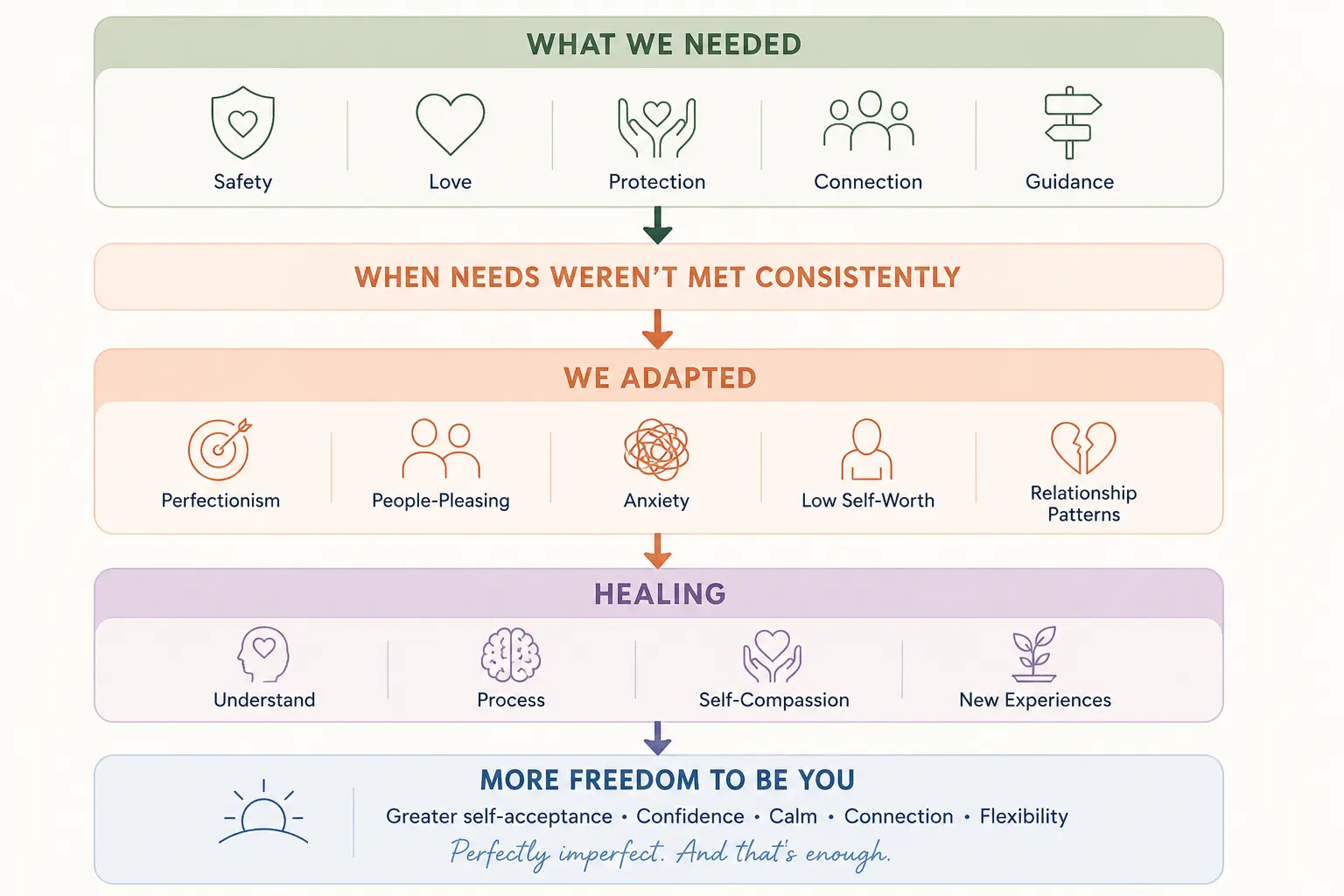
Sometimes it's about what happened repeatedly. And sometimes it's about what didn't happen — not feeling consistently safe, protected, understood, nurtured or emotionally supported when you needed it most.
These experiences can shape how you learn to see yourself, other people and the world. Years later, they may show up as low self-esteem, perfectionism, people-pleasing, chronic anxiety or difficulties in relationships — even when you don't immediately connect these struggles with your childhood.
I specialise in helping adults experiencing the effects of childhood and complex trauma.
- BACP Accredited Psychotherapist
- EMDR Europe Accredited Practitioner
- In Person in Prestwich, Manchester & Online Across the UK
Childhood Trauma Is About What Happened — and What Didn't
Just as a plant needs the right conditions and nutrients to grow, children need certain emotional conditions to develop securely.
We need to feel sufficiently safe, protected, loved, understood and guided. We need opportunities to play, explore and simply be children, without carrying responsibilities beyond what we're developmentally ready for.
No childhood provides these conditions perfectly — and it doesn't need to. What matters is having enough of them, consistently enough, to develop a reasonably secure sense of ourselves, other people and the world.
When important emotional needs repeatedly aren't met, or when experiences overwhelm a child's ability to cope, we adapt.
Those adaptations can be remarkably effective in childhood. The difficulty is that they don't necessarily disappear when the circumstances that created them are gone.
What once helped you survive, feel safe or belong may eventually become part of what's keeping you stuck.
You May Recognise Yourself If…
Many people come to therapy because of difficulties they're experiencing today, without initially realising how much these patterns may be connected with earlier experiences.
You may struggle to feel genuinely good enough, even when other people see you as capable or successful. Compliments don't quite sink in, while criticism can feel deeply personal.
You set very high standards for yourself and find mistakes difficult to tolerate. Achievements may bring temporary relief, but rarely leave you feeling good enough for long.
You find it difficult to disappoint people, say no or put your own needs first. You may be highly attuned to how other people are feeling while struggling to recognise what you need.
You may fear rejection or abandonment, struggle to trust, become overly dependent on reassurance, withdraw when relationships feel threatening, or find yourself losing your own needs within relationships.
You may feel as though you're constantly anticipating what could go wrong. Even when life is relatively safe, part of you remains alert, worried or unable to fully relax.
These patterns can make much more sense when we understand the circumstances in which they developed.
Why Can Childhood Still Affect Me as an Adult?
As children, we're dependent on the people around us to help us feel safe and make sense of ourselves and the world.
When experiences are frightening, confusing or emotionally overwhelming — or important needs aren't met consistently — we find ways to adapt.
We might learn:
- I need to be perfect to be accepted.
- Other people's needs matter more than mine.
- I shouldn't show how I feel.
- I need to keep everyone happy.
- I'm not good enough.
- The world isn't safe.
These beliefs and ways of coping can become deeply ingrained. You may grow up and intellectually understand that your circumstances have changed, while emotionally continuing to respond according to what you learned much earlier.
This is why simply telling yourself “I shouldn't feel like this” often doesn't work.
Something you learned emotionally can still feel true, even when intellectually you know that it isn't.
What Is Complex PTSD (CPTSD)?
Complex PTSD, often shortened to CPTSD, can develop following repeated or prolonged traumatic experiences, particularly when they occur within relationships or during periods when escape is difficult.
Alongside symptoms associated with PTSD, CPTSD can involve difficulties with emotional regulation, a persistently negative sense of self and relationships with other people.
But not everyone affected by difficult childhood experiences has CPTSD. You may simply recognise longstanding patterns of anxiety, shame, low self-esteem, perfectionism, people-pleasing or relationship difficulties that you would like to understand and change.
Neurodiversity can sometimes add another layer. Children with ADHD, autism or dyslexia may experience repeated misunderstanding, criticism, exclusion or pressure when their needs aren't sufficiently understood or supported. Over time, these experiences can also affect self-esteem, belonging and the developing sense of self.
What Does Healing Actually Mean?
Healing from childhood trauma doesn't mean erasing the past.
And it doesn't mean becoming a perfect, permanently confident person who is never anxious, upset or affected by what other people think.
It means gradually developing a different relationship with yourself — becoming more accepting of who you are, perfectly imperfect.
Recognising your strengths while accepting your vulnerabilities. Feeling neither better nor less than other people. Trusting yourself more. Being less governed by other people's approval. Being able to have needs, make mistakes and set boundaries without these things threatening your sense of worth.
It can also mean becoming more compassionate towards the ways you learned to cope.
Perfectionism, people-pleasing, emotional withdrawal or constantly anticipating danger may once have served an important purpose. Healing isn't about fighting these parts of yourself. It's about understanding why they developed, processing what still hurts and discovering that you may no longer need to live according to the same rules.
The aim is greater freedom to be who you are today, rather than who you learned you needed to be in order to feel safe, loved or accepted.
How I Work With Childhood & Complex Trauma
I take an integrative, attachment-informed and trauma-focused approach.
We begin by understanding what's happening in your life now and exploring the experiences, relationships, beliefs and protective strategies that may be contributing to it.
Together, we'll develop a shared formulation — an understanding of how the different pieces fit together and what may need to change.
But understanding is only part of the work.
Understanding is important, but understanding alone doesn't necessarily produce healing.
For many people, meaningful change also involves working experientially with emotions, memories, beliefs and parts of themselves that continue to carry the effects of earlier experiences.
Depending on your individual needs, therapy may draw on:
- EMDR — to help process experiences, emotions and beliefs that remain emotionally active.
- Internal Family Systems (IFS) and parts work — to understand and work compassionately with protective parts and those carrying painful experiences or beliefs.
- Experiential and chair work — to access emotions, unmet needs and relationship experiences that may be difficult to reach through talking alone.
- We may also draw on cognitive, behavioural, mindfulness and emotional-regulation approaches where helpful.
There isn't a predetermined sequence every client has to follow. Therapy is guided by our formulation and what emerges through the work.
The Therapeutic Relationship Matters
For people whose difficulties developed within relationships, the relationship experienced in therapy can itself be an important part of healing.
I aim to provide a relationship characterised by consistency, honesty, compassion, respect and genuine human connection.
Your sense of agency is particularly important to me. You remain involved in deciding what we work on and how quickly we move. You can disagree with me, change your mind, slow things down or tell me when something doesn't feel right.
Therapy can provide an opportunity to experience being understood without being judged, challenged without being shamed, and accepted without needing to be perfect.
Over time, the aim is not to become dependent on therapy, but to strengthen your ability to trust yourself, relate differently to others and feel safer being who you are.
Moving Forward
One of the shifts that can happen through trauma therapy is moving away from:
“What's wrong with me?”
and towards:
“What happened, what did I need, and how did I learn to cope?”
The patterns you developed make sense within the context of your experiences. But they don't have to define the rest of your life.
Alongside my professional training, I bring my own lived experience of childhood trauma and the therapeutic process. Your experiences will be different from mine, but my own journey has strengthened my belief that meaningful healing and change are possible.
You don't need to become somebody else. Sometimes healing is about feeling more at home in the person you already are.
I offer a free 15-minute Zoom consultation where we can briefly discuss what's bringing you to therapy, what you're hoping to change and whether my approach may be a good fit.
Frequently Asked Questions About Childhood Trauma & CPTSD
You don't need to decide that your childhood was “bad enough” or even call what happened to you trauma in order to come to therapy.
Many people tell me, “Other people had it much worse,” or “Nothing terrible happened to me.” But childhood trauma isn't only about dramatic events. Sometimes the lasting impact comes from experiences that happened repeatedly, or from important emotional needs that weren't met consistently enough.
Rather than comparing your childhood with somebody else's, we'll look at your experiences, what you needed at the time, how you adapted and whether those patterns are still affecting you today.
No. You don't need a diagnosis of Complex PTSD (CPTSD) to work with me.
Some people clearly identify with CPTSD, while others come because they're struggling with low self-esteem, perfectionism, people-pleasing, chronic anxiety, relationship difficulties or the effects of painful childhood experiences.
A diagnosis can sometimes provide a useful framework, but therapy doesn't depend on having one.
No. Therapy isn't about deciding that your parents were “good” or “bad”, nor will I tell you how you should feel about them.
Some people love their parents and find it difficult to acknowledge ways in which their childhood affected them. Others feel angry, hurt or have chosen not to have a relationship with a parent at all.
Our focus is on your experience: what happened, what you needed, how it affected you and what you may still be carrying today.
Healing doesn't require changing your parents, receiving an apology or creating a different childhood. The work is about helping you process your experiences and develop a different relationship with yourself and your past.
That's okay. You don't need a detailed memory of your childhood for therapy to be helpful, and having gaps in your memory doesn't by itself mean that you've experienced trauma.
We can begin with what's affecting you today — perhaps a feeling, belief, relationship pattern or situation that repeatedly triggers you — and explore it from there.
Sometimes relevant memories or connections emerge naturally during therapy. There's no need to force or search for memories that aren't there.
I believe meaningful healing is possible.
Healing doesn't mean forgetting what happened or reaching a point where nothing ever affects you again. It can mean that the past no longer governs your life in the same way — old experiences become less emotionally charged, longstanding beliefs about yourself can change, and protective patterns that once felt necessary may begin to relax.
Therapy can help you bring the strengths, choices and resources you have as an adult today to experiences that developed when those resources weren't available to you.
If harmful or unsafe circumstances are still ongoing, our priorities may be different. Therapy may initially focus more on support, boundaries, coping and increasing safety rather than trying to process something that isn't entirely in the past.
There isn't a fixed timeframe.
Some people begin noticing meaningful changes relatively early in therapy. For others, particularly where difficulties developed across many years or involve several interconnected experiences and relationships, the work may be longer-term.
Complex doesn't necessarily mean that change has to take years, but I also don't want to promise that something which developed over a lifetime can be resolved within a predetermined number of sessions.
We'll agree goals together and review your progress regularly, so that therapy remains focused on what you want to change rather than continuing indefinitely without direction.
No. You remain in control of what you choose to share.
Understanding your experiences is important, but you don't have to disclose every detail or tell your entire childhood story before therapy can help.
Because I also use experiential approaches such as EMDR, IFS and chair work, therapy isn't limited to repeatedly talking about what happened. We can work with emotions, beliefs, bodily responses and patterns while respecting your boundaries and moving at a pace that feels manageable.
I work integratively rather than using one therapy with every client.
We first develop a shared understanding of your difficulties and how your experiences may be contributing to them. Depending on your needs, therapy may then draw on EMDR, Internal Family Systems (IFS), parts work, experiential/chair work, and cognitive, behavioural, mindfulness or emotional-regulation approaches.
Different approaches can help with different aspects of the work. The aim isn't to use as many techniques as possible, but to choose thoughtfully according to your individual formulation, goals and what emerges during therapy.
This is something I hear frequently.
You might understand exactly why you developed low self-esteem or people-pleasing. You may know that what happened wasn't your fault or that you no longer need to be perfect to be accepted.
And yet, emotionally, it can still feel true.
This is an important distinction in the way I work. Understanding is important, but understanding alone doesn't necessarily produce healing.
That's why my approach includes experiential therapies such as EMDR, IFS and chair work alongside talking and reflection. These approaches give us ways of working with the emotions, beliefs and responses that remain active, rather than only understanding where they came from.
Get in touch
Reaching out for therapy can feel like a big step. If you feel ready, I invite you to book a free 15-minute Zoom consultation. We can briefly talk about what you’re looking for help with, answer any questions you have, and see whether I might be the right therapist for you. If you’d prefer a phone call, that’s absolutely fine too.
Practical Information
- 55-minute sessions
- £75 per session
- Adults 18+
- In person in Prestwich, Manchester, or online across the UK
- Private health insurance: AXA, Aviva and Allianz
- I aim to respond to enquiries within 24 hours
Confidentiality
Your enquiry will be treated confidentially. Please avoid including highly sensitive personal information in the initial contact form.
© Therapy with Philipp
Powered by WebHealer
Manchester Therapies Ltd. Registered in England. Company No: 13398491. Registered office. Chartwell Accountants, 47 Bury New Road, Prestwich, Manchester, England, M25 9JY