
Therapy with Philipp
PSYCHOTHERAPist IN Prestwich, Manchester & online

OCD Therapy
Helping you break free from intrusive thoughts, compulsions and the cycle that keeps OCD going.
Living with OCD can be exhausting. Whether you're struggling with intrusive thoughts, compulsions, constant doubt or the need for reassurance, OCD can begin to take over everyday life.
Perhaps you're worried you'll harm someone you love, become contaminated, make a terrible mistake, offend God, or constantly question what your intrusive thoughts might say about you. You may spend hours checking, analysing, mentally reviewing, seeking reassurance or avoiding situations altogether. Even when you recognise that your fears are unlikely, the "what if?" can feel impossible to ignore.
The good news is that effective treatments for OCD are available, and many people experience meaningful improvement. My aim is to help you understand what is keeping your OCD going and work collaboratively towards helping you regain a greater sense of freedom, confidence and peace of mind.

Does this sound familiar?
You may recognise yourself if you:
Feel trapped by intrusive thoughts that go against your values.
Spend time checking, analysing, mentally reviewing or seeking reassurance.
Avoid certain situations, objects or people because they trigger anxiety.
Constantly question yourself despite having little evidence that something is wrong.
Feel exhausted by the endless cycle of doubt and uncertainty.
Have tried to fight or suppress your thoughts but find they keep coming back.
Understanding OCD
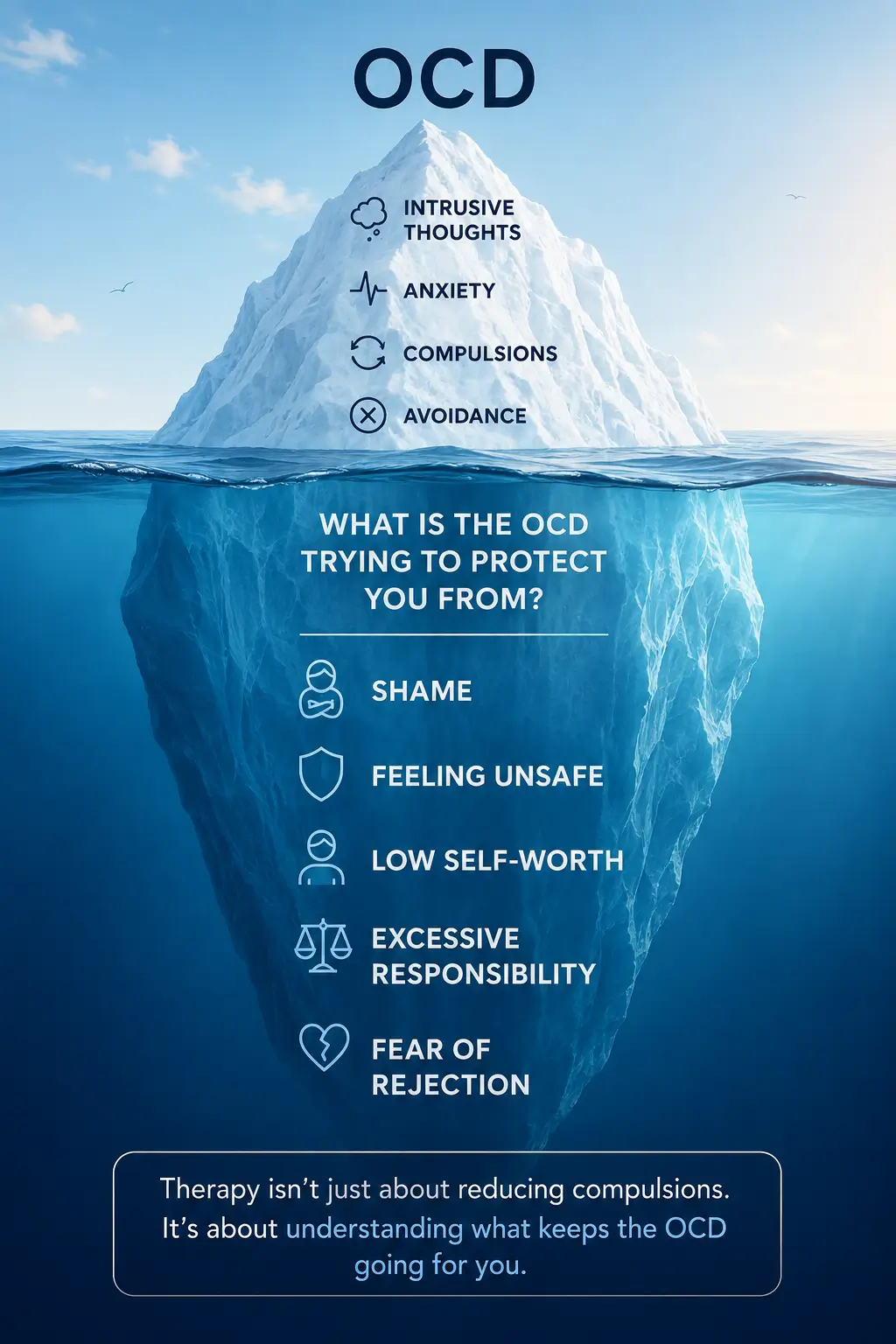
Many people think OCD is simply about intrusive thoughts and compulsions.
While these are certainly part of OCD, I've found that therapy is often most effective when we also understand what is keeping the OCD going for you.
Iceberg
My Approach to OCD
There isn't a single treatment that suits everyone with OCD.
Rather than assuming everyone needs the same approach, I begin by developing a shared understanding of what may be maintaining your OCD. This helps us decide which therapeutic approaches are likely to be most helpful for you.
Depending on your formulation, therapy may draw on one or more of the following approaches.
Exposure and Response Prevention (ERP)
ERP is considered one of the most effective treatments for OCD.
Together we'll gradually reduce compulsions, reassurance seeking and avoidance while learning that anxiety naturally rises and falls without needing rituals or certainty.
Inference-Based CBT (I-CBT)
One of the things OCD does remarkably well is convince us not to trust what we can actually see, hear or know, replacing reality with frightening "what if?" stories.
I-CBT helps you recognise when this happens by learning to:
distinguish normal doubt from OCD doubt
recognise the OCD story
rebuild trust in your own senses and judgement
Acceptance and Commitment Therapy (ACT)
Rather than trying to eliminate intrusive thoughts, ACT helps you develop a different relationship with them.
Instead of becoming caught in endless arguments with OCD, you'll learn practical skills to reduce the power these thoughts have over your behaviour while reconnecting with the life that's important to you.
EMDR
Sometimes OCD becomes closely connected with painful experiences or deeply held beliefs about ourselves.
EMDR can help process these experiences, reducing their emotional impact while supporting the broader therapeutic work. For some people, this makes it easier to move forward with other aspects of therapy and creates opportunities for deeper, longer-lasting change.
Why I Integrate These Approaches
Every person with OCD is different.
Some people benefit primarily from behavioural work. Others discover that the OCD has become closely connected with shame, responsibility, low self-worth or feeling unsafe. For many people, it's a combination of both.
Rather than trying to fit everyone into one therapy model, I believe it's important to understand the unique processes maintaining your OCD before deciding which therapeutic approaches are likely to be most helpful.
My aim is to provide therapy that is collaborative, evidence-based and tailored to your individual needs, helping you develop both practical skills for managing OCD and opportunities for deeper, lasting recovery.
Why Work With Me?
- I specialise in helping adults experiencing the effects of OCD and childhood trauma.
- EMDR Europe Accredited Practitioner.
- BACP Accredited Psychotherapist.
- Lived experience of OCD and complex trauma.
- Integrative, formulation-led approach combining ERP, I-CBT, ACT and EMDR.
- Free 15-minute consultation to help you decide whether we're the right fit.
Frequently Asked Questions About OCD Therapy
Yes. Effective treatments for OCD are available, and many people experience meaningful improvement. Approaches such as Exposure and Response Prevention (ERP), Inference-Based CBT (I-CBT), Acceptance and Commitment Therapy (ACT) and EMDR can help address different aspects of OCD and the processes that may be keeping it going.
Rather than assuming everyone needs the same treatment, I begin by developing a shared understanding of what may be maintaining your OCD. Together, we'll decide which therapeutic approaches are likely to be most helpful for you.
I work with a wide range of OCD presentations, including Harm OCD, Pure O (Purely Obsessional OCD), Relationship OCD (ROCD), Contamination OCD, Religious OCD (Scrupulosity), Sexual Orientation OCD (SO-OCD), Paedophile OCD (POCD), and Checking and Responsibility OCD.
Whatever the content of your OCD, my focus is not only on the particular theme but also on understanding the processes that keep it going for you.
No. Exposure and Response Prevention (ERP) is one of the most established treatments for OCD and can be an important part of therapy, but I don't believe everyone needs exactly the same approach.
Depending on what is maintaining your OCD, we may also draw on I-CBT, ACT, EMDR or other therapeutic approaches. Therapy is collaborative, and together we'll decide which approaches are likely to be most helpful for you.
Because OCD doesn't look or function exactly the same way for everyone. Some people may particularly benefit from reducing compulsions and avoidance, while others may also need help recognising OCD's imagined stories, trusting their own judgement, changing their relationship with intrusive thoughts, or addressing deeper emotional experiences and beliefs.
Rather than relying on one model alone, I integrate approaches such as ERP, I-CBT, ACT and EMDR according to your individual formulation. The aim isn't to fit you into a particular therapy model, but to understand what's keeping your OCD going and tailor therapy accordingly.
EMDR is increasingly being explored as part of OCD treatment, although the research is still developing and ERP remains a well-established treatment for OCD.
In my work, I don't generally use EMDR simply to target the obsession itself. My approach is more attachment-informed. Sometimes OCD becomes closely connected with earlier painful experiences, shame, feeling unsafe, low self-worth, excessive responsibility or fears about who we might be. EMDR can help us work with experiences and beliefs that may be giving the OCD some of its emotional intensity.
This doesn't mean that OCD is always caused by trauma or that everyone with OCD needs EMDR. It is one of several approaches we can draw upon, alongside ERP, I-CBT and ACT, depending on your individual formulation.
One of the most frustrating aspects of OCD is that it can gradually undermine trust in your own senses and judgement. You may know something is probably fine and yet find yourself thinking, "But what if...?" This can lead to checking, analysing, mentally reviewing or seeking reassurance in an attempt to feel certain.
Part of therapy can involve learning to recognise the difference between ordinary doubt and OCD doubt, noticing when OCD has pulled you away from what your senses are telling you and into imagined possibilities, and gradually rebuilding trust in your own judgement.
The aim isn't to achieve absolute certainty. It's to become better able to recognise OCD's doubts without needing to resolve every one of them.
Usually I am asked this question by people who are nervous about entering into counselling, or when they are looking for support in coming to see a therapist. This anxiety is understandable, but a key aspect of therapy is that you should feel free to talk about any issues you feel are important to you. Having someone else with you who can be connected those issues makes this opening-up more difficult, so for this reason I do not see clients accompanied by friends or family.
Yes, people can recover significantly from OCD. For some, symptoms reduce to the point that OCD has very little impact on everyday life. Others may still experience occasional intrusive thoughts or periods when OCD becomes louder, particularly during times of stress.
The goal of therapy isn't necessarily to ensure you never have another intrusive thought—we all have unwanted thoughts. It's to reach a place where those thoughts no longer frighten you in the same way, you don't feel compelled to respond to them, and OCD no longer dictates how you live your life.
Recovery can look less like never having an OCD thought again, and more like being able to have the thought and get on with your life.
Get in touch
Reaching out for therapy can feel like a big step. If you feel ready, I invite you to book a free 15-minute Zoom consultation. We can briefly talk about what you’re looking for help with, answer any questions you have, and see whether I might be the right therapist for you. If you’d prefer a phone call, that’s absolutely fine too.
Practical Information
- 55-minute sessions
- £75 per session
- Adults 18+
- In person in Prestwich, Manchester, or online across the UK
- Private health insurance: AXA, Aviva and Allianz
- I aim to respond to enquiries within 24 hours
Confidentiality
Your enquiry will be treated confidentially. Please avoid including highly sensitive personal information in the initial contact form.
© Therapy with Philipp
Powered by WebHealer
Manchester Therapies Ltd. Registered in England. Company No: 13398491. Registered office. Chartwell Accountants, 47 Bury New Road, Prestwich, Manchester, England, M25 9JY